(PDF) Kafka, Benjamin, Derrida On Violence, Law and Justice

In the 1970s and 80s, the philosophical works of Jacques Derrida became known well beyond the borders of France and beyond the limits of the French language. It was a radical and disturbing new form of materialism which made Derrida's thought so notorious: a philosophy of writing, of différance, of the movements of negation which always escape our grasp - with the effect that all.
[PDF] The Force of Law and Literature Critiques of Ideology in Jacques Derrida and Pierre

Derrida, Jacques "Force of Law: The 'Mystical Foundation of Authority,'" Cardozo Law Review 11 (1990): 919-1045. Also published in D. Cornell et al., eds. Deconstruction and the Possibility of Justice.. Available formats PDF Please select a format to save. By using this service, you agree that you will only keep content for.
(PDF) "Derrida, Democracy and Violence"

This first definition of deconstruction as two phases gives way to the refinement we find in the "Force of Law" (which dates from 1989-1990). This second definition is less metaphysical and more political. In "Force of Law," Derrida says that deconstruction is practiced in two styles (Deconstruction and the Possibility of Justice, p.
(PDF) ÉTICA E DESCONSTRUÇÃO JUSTIÇA E LINGUAGEM DESDE “FORCE DE LOI LE ‘FONDEMENT MYSTIQYE DE

In 'Force of Law', Derrida's discussion of the 'unstable' distinction between law and justice exemplifies the deconstructive double bind and makes this a very significant text in virtue of its juridical, political and ethical import. The first section focuses on Derrida's deployment of the polysemous term 'force'. 'Force' refers to the enforceability of the law but also to.
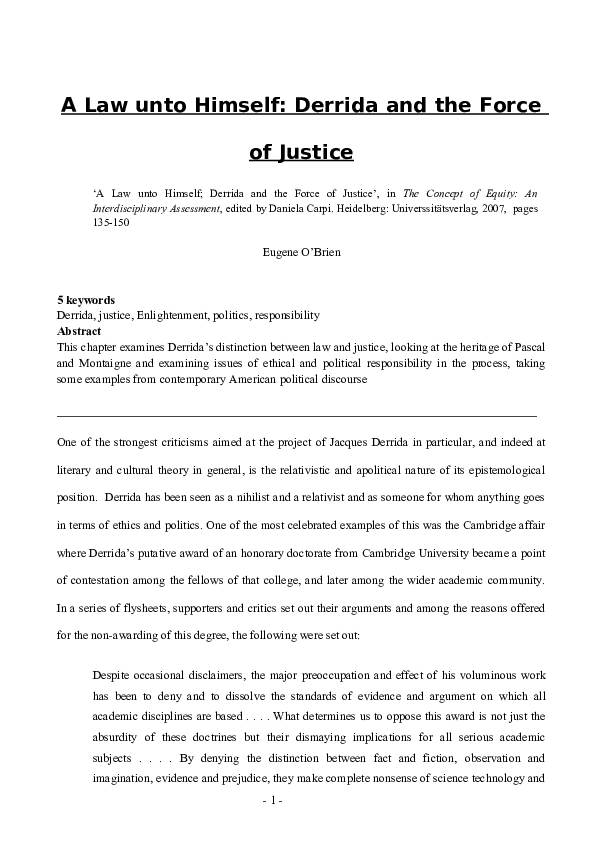
(DOC) A Law unto Himself Derrida and the Force of Justice Eugene O'Brien Academia.edu
Part I of Derrida's "Force of Law: 'The Mystical Foundation of Authority"' was delivered (both read and distributed) at the colloquium "Deconstruction and the Possibility of Justice" and it is certainly this event that provides the contextual framework, the parergon3, for Derrida's text. In fact, Derrida addresses this context, as described
Derrida "Force of Law The Mystical Foundation of Authority '" in The Acts of Religion PDF

Desire and Language in Derrida's Force of Law. Jacques de Ville, Cape Town and Berlin*. Abstract: In this article the author proposes a reading of Force of Law from two angles: boundless desire and the 'law' of language. The author contends that an analysis from these perspectives casts new light on the notion of the 'mystical', as.
(PDF) Derrida Online
"Force of Law: The Mystical Foundation of Authority" in trans. Mary Quaintance, Cardozo Law Review 11 (1989-1990): pp. 920-1045. By questioning law's rather "violent," "polemical," "inquisitorial" character [Force of Law] intrusively asks the questions of whether deconstruction permits or denies any just action, any discourse about justice; whether it constitutes a threat to.
Jaque Derrida Force de Loi PDF Droit statutaire Justice

In 'Force of Law', Derrida's discussion of the 'unstable' distinction between law and justice exemplifies the deconstructive double bind and makes this a very significant text in virtue of its juridical, political and ethical import. The first section focuses on Derrida's deployment of the polysemous term 'force'.
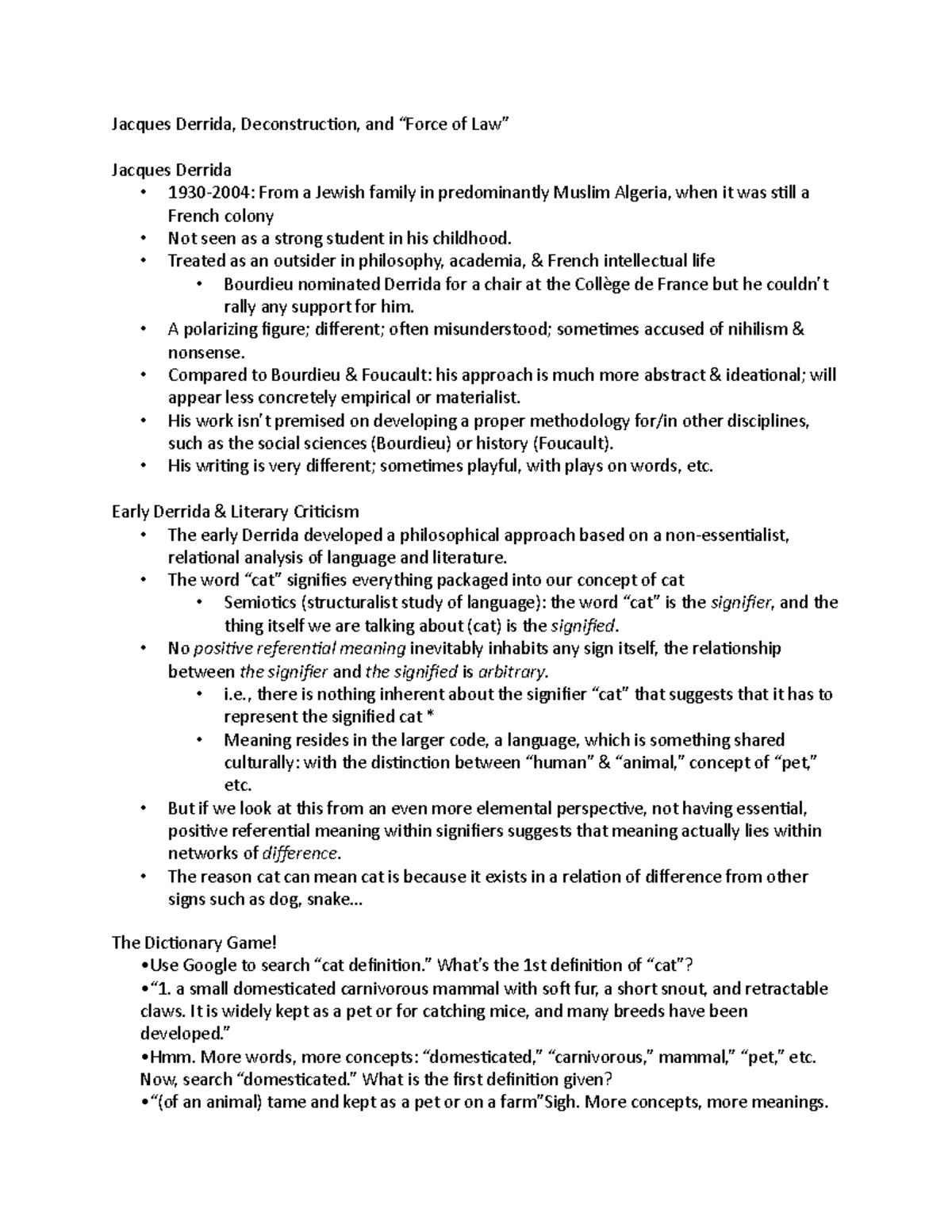
Soc3310 test 2 lecture and power point notes Jacques Derrida, Deconstruction, and “Force of
We would like to show you a description here but the site won't allow us.
Law’s Trace From Hegel to Derrida Simon Gros

And hence it is 'just that there be law'. In 'Force of Law' Derrida asserts that what he has called 'the mystical' is related to what he calls the aporetic character of any experience of the 'there is' of justice ( 1992, p. 15). This relationship between present laws and the unpresentable 'there is' of justice that is.
(PDF) Derrida Enunciates the "Principles" of Deconstruction

Abstract. In 'Force of Law', Derrida's discussion of the 'unstable' distinction between law and justice exemplifies the deconstructive double bind and makes this a very significant text.
(PDF) Derrida and the Philosophy of Law and Justice

Abstract. In this article I argue that Jacques Derrida is correct in holding that the law is always an authorized force but that he is mistaken in suggesting that its ultimate font or origin (what he calls the 'mystical foundation of authority') is an originary or 'foundationalional' act of violence. I suggest that Derrida and, more.
(PDF) BartlebyDerrida Literature, Law and Responsibility shela sheikh Academia.edu

Book Deconstruction and the Possibility of Justice. Edition 1st Edition. First Published 1993. Imprint Routledge. Pages 65. eBook ISBN 9781315539744. Force of Law: The "Mystical Foundation of Authority" - 1.
Jacques Derrida and Deconstruction PDF PDF Deconstruction Jacques Derrida

DOI: 10.21276/sb.2018.4.1.2 Abstract: Jacques Derrida is among influential Post Structuralist philosophers. Post structuralism is the major subdivision of contemporary western philosophy. This doctrine fundamentally seeks to attain justice (balance) of language and culture as far as acquisition and development in use is concerned. This phenomenon started to be felt in 1970s. Philosophers under.
(PDF) The ends of violence. Girard and Derrida

Derrida wants to affirm in his text 'Force of law: The ''Mystical Foundation of Authority''' (Derrida 1992). However, the subtitle to that text complicates that simplicity. The simple summary might suggest that the foundation of the authority of the law is external to justice: it is power, political power, a power which is
Derrida and Law 9780754628262 Pierre Legrand Boeken
See Derrida, "Force of Law," p,263, note 26 for a full bibliographical entry. The German gewalt connotes "force," but in a number of registers, including the legal force